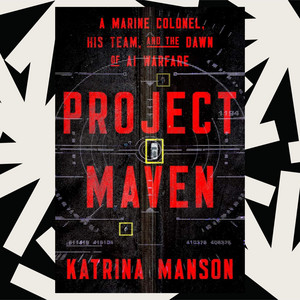
Project Maven
A Marine Colonel, His Team, and the Dawn of AI Warfare
by Katrina Manson2026W. W. Norton & Company
Katrina Manson, a Bloomberg national-security reporter who had covered defense for the Financial Times since Project Maven launched in 2017, spent more than two hundred interviews and a year of weekly calls with the programme’s driving force, Marine Corps Colonel Drew Cukor, to produce the first long-form reported history of how artificial intelligence arrived on the American battlefield.
The book argues that AI did not enter warfare through some grand strategic decision in Washington but through one colonel’s relentless campaign to drag the Pentagon, Silicon Valley and a sceptical national-security establishment into the age of algorithmic warfare. Cukor, whom Palantir chief executive Alex Karp calls the “founding father of AI targeting,” is the unmistakable engine of the change. Manson treats him as both indispensable and discomfiting — a Don Quixote figure jousting at Pentagon windmills while quietly building the machinery that may one day pick its own targets.
The narrative follows the targeting cycle’s four phases — Find, Fix, Finish, Feedback — from Cukor watching the AlphaGo documentary at home in 2017 to the first Maven algorithm being switched off in Somalia for labelling clouds as school buses; from the 2018 Google employee revolt led by William Fitzgerald, Meredith Whittaker and Laura Nolan to the company’s quiet handover of its Maven algorithms to the startup Xnor, which sent them to war in Afghanistan anyway. Maven flagged a moving van seconds before a strike during the October 2019 raid that killed Abu Bakr al-Baghdadi, tracked Qasem Soleimani’s car from Baghdad airport in January 2020, and helped destroy a donkey train carrying homemade explosives through the Hindu Kush. The book then moves into Ukraine, where the 18th Airborne Corps in Wiesbaden used Maven Smart System to pass tens of thousands of points of interest to Ukrainian forces — peaking at 267 in a single day — and into the AUKUS undersea surveillance programme Harbinger, in which Maven algorithms now sit inside submarines listening for Russian and Chinese boats.
Manson reports that Maven has lifted US targeting capacity from under a hundred targets a day to five thousand, that NATO began using the system in spring 2025 with ten members lining up to adopt it, and that Maven algorithms now live inside at least two highly classified autonomous systems intended for the defence of Taiwan. She is careful with the harder cases, including the August 2021 Kabul drone strike that killed an aid worker and seven children, where Maven was off but where the algorithms, run on the footage afterwards, would also have missed the moving shadows of the children at dusk.
Set against earlier work by Christian Brose, Paul Scharre and Eric Schmidt, the volume’s distinction is access — the inside account of how one specific programme, run by one specific colonel, persuaded a sceptical Pentagon and a hostile Silicon Valley to build the targeting plumbing of the next war.
Read the longer summary
Katrina Manson’s Project Maven: A Marine Colonel, His Team, and the Dawn of AI Warfare opens with Drew Cukor watching the AlphaGo documentary on a 2017 evening at home, scribbling notes as Lee Sedol unravelled before a Google DeepMind program that played moves no human had imagined. To the Marine colonel sitting in front of the television, the lesson was not about a board game. It was about war. A human alone would never be enough; a human with a machine, properly built and trusted, would always win. Cukor was about to be handed the task of putting artificial intelligence at the centre of how the United States fights, and Manson, a Bloomberg national security correspondent who had covered defence for the Financial Times since 2017, spent more than two hundred interviews and a year of weekly phone calls with Cukor turning that mission into a book that doubles as the first long-form reported history of Project Maven and as a portrait of the bureaucratic insurgent who drove it.
The book’s central argument is that AI did not arrive on the battlefield through some grand strategic decision in Washington but through a single Marine colonel’s relentless campaign to drag the Pentagon, Silicon Valley and a sceptical national-security establishment into the age of algorithmic warfare. Maven, Manson contends, is the spine of a much larger story: the moment at which the United States, humbled by failure in Afghanistan and Iraq and increasingly fearful of China, tied its hopes of sustaining military superiority to commercial AI companies, and in doing so reshaped both the Pentagon and Silicon Valley. The thesis is not that this was inevitable, nor that it was wise, but that it happened, that it happened faster and further than the public has been told, and that the people who made it happen acted with an intensity that bordered on zealotry. Cukor, whom Palantir’s Alex Karp calls the “founding father of AI targeting”, is the unmistakable engine of the change; Manson treats him as both indispensable and discomfiting, a Don Quixote figure who jousts at Pentagon windmills while quietly building the machinery that will one day pick its own targets.
The structure follows the four phases of the military targeting cycle the book takes as its frame. Part one, “Find”, traces Cukor from the cockpit of a Marine helicopter approaching Kandahar in late 2001, a useless laptop on his lap, through his 1997 master’s thesis arguing that the Marine Corps had to be remade for a war it could not yet see, into his initial 2010 fight to push Palantir’s data platform onto Marines in Helmand against the objections of the Army and its $1.6 billion intelligence program of record. It then sets up the Pentagon’s so-called Breakfast Club under Deputy Defense Secretary Bob Work, the deputy’s drive for autonomy as the United States’ next “offset” against China, and Cukor’s 2017 pitch to use AI to make sense of the tsunami of drone full-motion video the Pentagon was drowning in. The chapter on the founding of Maven, formally the Algorithmic Warfare Cross-Functional Team, dwells on the people Cukor handpicked, the Marine reservists who came to call themselves Mavenites, and on the eighteen-hour days, the pretzel-can explosions and the rejected snacks that came with working for a man who, colleagues warned each other, was a noun, a verb and an adjective. Part two, “Fix”, follows Maven’s first algorithm into Somalia in December 2017, where it labelled clouds as school buses and was promptly switched off; the recruitment of Clarifai, Pilot AI, Xnor and IDenTV as the country’s first AI defence contractors; the 2018 Google revolt led from inside the company by William Fitzgerald, Meredith Whittaker and Laura Nolan that forced the company to drop the Maven contract and sent the Pentagon’s relationship with Silicon Valley into a public crisis; and Cukor’s quieter triumph in luring Microsoft, Amazon Web Services and eventually Palantir into the breach. Part three, “Finish”, brings Maven into combat, from the night of the October 2019 raid that killed Abu Bakr al-Baghdadi, where AI flagged a van moving towards US forces seconds before a strike obliterated it, to the January 2020 killing of Qasem Soleimani, where Maven’s algorithms tracked his car from Baghdad airport; from the donkey trains carrying ISIS-K explosives through the Hindu Kush, identified through Gorgon Stare and back-tracking algorithms, to Colonel Joseph O’Callaghan’s first AI-derived target, an old tank hull destroyed on a Fort Bragg range in August 2020. Part four, “Feedback”, which the available text only begins to enter, picks up Ukraine, the moral and political reckoning around lethal autonomous weapons, the Trump administration’s renaming of the Pentagon as the “Department of War”, and the deals that have made Palantir, Anduril, Shield AI, Scale AI, Anthropic and OpenAI into the new defence-industrial complex.
The book is at its strongest in its examples, which are concrete, often startling, and reported from inside rooms most journalists never reach. Manson describes the first Maven appliance, a $2 million box whose eight GPUs literally melted on first attempt and had to be redesigned by a contractor at ECS Federal who would later marry the project manager. She follows Justin Guzzardo, a tattooed former Air Force drone screener, into a plywood shack in Somalia where he persuades special operators to turn the AI back on by working their shifts beside them. She details the data-labelling debacle in which a disgruntled service member drew a penis and the letters F, U, C and K across training imagery, poisoning the pipeline that was meant to teach the algorithms to distinguish a man from a child. She is equally precise on the technical detail: the Maven Smart System overlaying yellow bounding boxes from AI detections, blue boxes when a signals-intelligence intercept corroborated the visual hit, the augmented-reality range rings drawn around potential strike sites, the eight-second satellite image load times in Wiesbaden that nearly led General Erik Kurilla to ban the system from the Pit in the bowling alley where US forces ran the early days of the Ukraine war. The set pieces include the destruction of a donkey train carrying homemade explosives through southern Nangarhar, a strike whose moral framing depends entirely on whether one believes the unarmed men walking beside the animals were ISIS fighters or farmers; the September 2019 SEAL Team 6 deployment of Maven into Djibouti for operations across Somalia and Libya; the August 2021 evacuation of Kabul, when Maven was used to count the crowds at Hamid Karzai International Airport and convince Pentagon leaders just how badly the situation had slipped; and the August 2022 Wiesbaden surge in which Maven helped the 18th Airborne Corps pass tens of thousands of points of interest to Ukrainian forces, peaking at 267 in a single day. Manson is careful with the harder cases, including the August 2021 drone strike that killed an aid worker and seven children in Kabul, a strike in which Maven was not switched on but where Brian Ward later ran the imagery through the algorithms to find that they too would have missed the moving shadows of the children at dusk.
The book’s reception will be shaped by its claim that Maven is now far deeper into the kill chain than the Pentagon has admitted, and that this happened with the active participation of companies whose chief executives once swore never to build weapons. Manson reports that NATO began using Maven Smart System in spring 2025 with ten members lining up to adopt it, that Maven’s combination of computer vision and large language models has lifted US targeting capacity from under a hundred targets a day to five thousand, that Maven algorithms now sit inside submarines under the AUKUS pact, on autonomous drone boats, and inside at least two highly classified systems intended for the defence of Taiwan that can surveil, select and kill on their own. She reports that Google’s own Project Maven algorithms, after the company’s 2018 withdrawal, were quietly transferred to the startup Xnor and went to war in Afghanistan in 2018 anyway, running on Gorgon Stare-equipped Reapers; that Alex Karp now describes peace activists as an infection in American society; that Shyam Sankar of Palantir nailed a manifesto styled after Martin Luther’s to the Pentagon metro entrance demanding the restoration of a dual-use industrial base; and that Google’s revised AI principles in February 2025 quietly removed the prohibition on building AI for weapons. The counterpoints, voiced by Mary Wareham of Human Rights Watch, by the campaigner Whittaker, by the engineer Joe Redmon who stopped doing computer vision altogether, are given room. So is the moral case made by retired four-star General Jim McConville, whose hesitation in front of an Iraqi van once saved a civilian family and who now worries that AI cannot hesitate at all. The book’s most uncomfortable passage concerns the April 2020 anonymous complaint about Maven sent to then-Under Secretary of Defense for Intelligence Joe Kernan, which triggered an investigation, a formal letter of reprimand for Cukor in mid-2020 about his supervision of junior officers, and the colonel’s exit at his thirty-year retirement date in October 2021, ten days before he started work at JP Morgan as J. Dimon’s transformation lead for artificial intelligence.
Manson places Project Maven inside a wider field of writing about AI in war that runs from Christian Brose’s The Kill Chain through Paul Scharre’s Army of None and Four Battlegrounds to Eric Schmidt and others’ Special Competitive Studies Project reports. Where those books argue for or against, Manson reports. She acknowledges the cheerleaders, who argue that AI will reduce civilian harm and may deter a war with China, and the detractors, who point out that AI has already led to civilian deaths in Gaza, Ukraine and Afghanistan, that the United Nations’ aim to ban lethal autonomous weapons by 2026 is now a lost hope, and that the entanglement of Big Tech with the Pentagon is, as Whittaker warned in 2018, the arrival of a new military-industrial complex. The book pairs naturally with Mark Bowden’s The Finish on the bin Laden raid for its sense of how the targeting cycle actually feels inside the room, with Annie Jacobsen’s The Pentagon’s Brain on DARPA, with Sharon Weinberger’s The Imagineers of War, and with Scharre’s Four Battlegrounds for the China comparison. What Manson adds that none of those have is the inside account of how one specific programme, run by one specific colonel, persuaded a sceptical Pentagon and a hostile Silicon Valley to build the targeting plumbing of the next war. What she does not cover is the receiving end: there is little here from Ukrainian gunners about what it feels like to fire on co-ordinates handed over by an American algorithm, and almost nothing from Chinese strategists about how Beijing’s own pursuit of “intelligentised warfare” is actually progressing beyond the public statements Manson dutifully translates.
For anyone reading widely on the present-day arrival of AI in war, Project Maven is the book that anchors the field in a single reported narrative. It is the most detailed account yet of how American AI warfare moved from a windowless Pentagon basement to the front lines in Iraq, Somalia, Afghanistan, Syria and Ukraine, and of the particular blend of bureaucratic guile, founder-style intensity and outright defiance of policy that made it move. The durable part of the book is likely to be its reporting on the personalities and the specific contracts, particularly the rescue of Palantir from near-irrelevance through Maven, the recruitment and revolt of Google, the integration of submarine acoustic data under AUKUS through Project Harbinger, and the 18th Airborne Corps’s Scarlet Dragon exercises that turned a single tank-hull strike into a doctrine for AI-enabled fires. What may date faster is the technical detail, since the convolutional neural networks Maven began with have already given way to transformer models, and the Maven Smart System Manson describes is being absorbed into a generation of platforms that combine vision models with large language models in ways the book can only gesture at. Cukor, characteristically, has already told her that the next war will be fought with AI almost free in China and that adoption, not invention, is now the constraint. Whether his protégés are right that this will save lives, or his critics are right that it will quietly normalise machine killing, is the question the book leaves with the reader, and one that the next decade, not this volume, will answer.
Publisher's description
Publisher data is pending — Google Books quota deferred until 2026-10-23T02:30:11.421608+00:00.
Watch & listen


Podcasts
Can Humans Still Control AI-Assisted Kill Chains? (with Katrina Manson)
Future of Life Institute Podcast · apple · 2026-09-25


How AI is transforming warfare and the US military with Katrina Manson
GZERO World with Ian Bremmer · apple · 2026-05-09
Katrina Manson — Project Maven: A Marine Colonel, His Team, and the Dawn of AI Warfare - with Gary Marcus
Politics and Prose Presents · apple · 2026-04-12
Katrina Manson on 'Project Maven' and how the U.S. is using AI in warfare
NPR's Book of the Day · apple · 2026-04-09
Inside Project Maven and AI-Powered Warfare with Katrina Manson
The AI Policy Podcast · apple · 2026-03-26
America's first AI-fueled war is unfolding. How'd we get here?
Fresh Air · apple · 2026-03-26
Katrina Manson: Project Maven and the Advent of Algorithmic Warfare
CTRL + ALT + DEFENSE · apple · 2026-03-24
Sources
- — Primary source — the book itself. The long summary is built from the full text; the local file is held privately (gitignored) and never published.
- wwnorton.com/books/project-maven (2026-06-21) — Publisher page (W. W. Norton) — confirms title/subtitle, Katrina Manson as author, 2026, and the book's subject (Drew Cukor and the Pentagon's Project Maven).
- www.amazon.com/Project-Maven-Marine-Colonel-Warfare/dp/1324123311 (2026-06-21) — Amazon listing — ISBN 9781324123316.
- breakingdefense.com/2026/04/inside-the-rise-of-project-maven-and-ai-warfare-book-excerpt/ (2026-06-21) — Breaking Defense — book excerpt on the rise of Project Maven and AI warfare.
- www.techpolicy.press/project-maven-and-the-age-of-ai-warfare/ (2026-06-21) — Tech Policy Press — review/analysis of the book and the programme.
Last researched .