CA-1 Europa
Mass-producible autonomous combat jet in the three-to-five-tonne class, natively flown by Helsing's Centaur AI pilot and built at its Grob Aircraft subsidiary.
Aircraftby HelsingIntroduced 2025 · Updated 2026
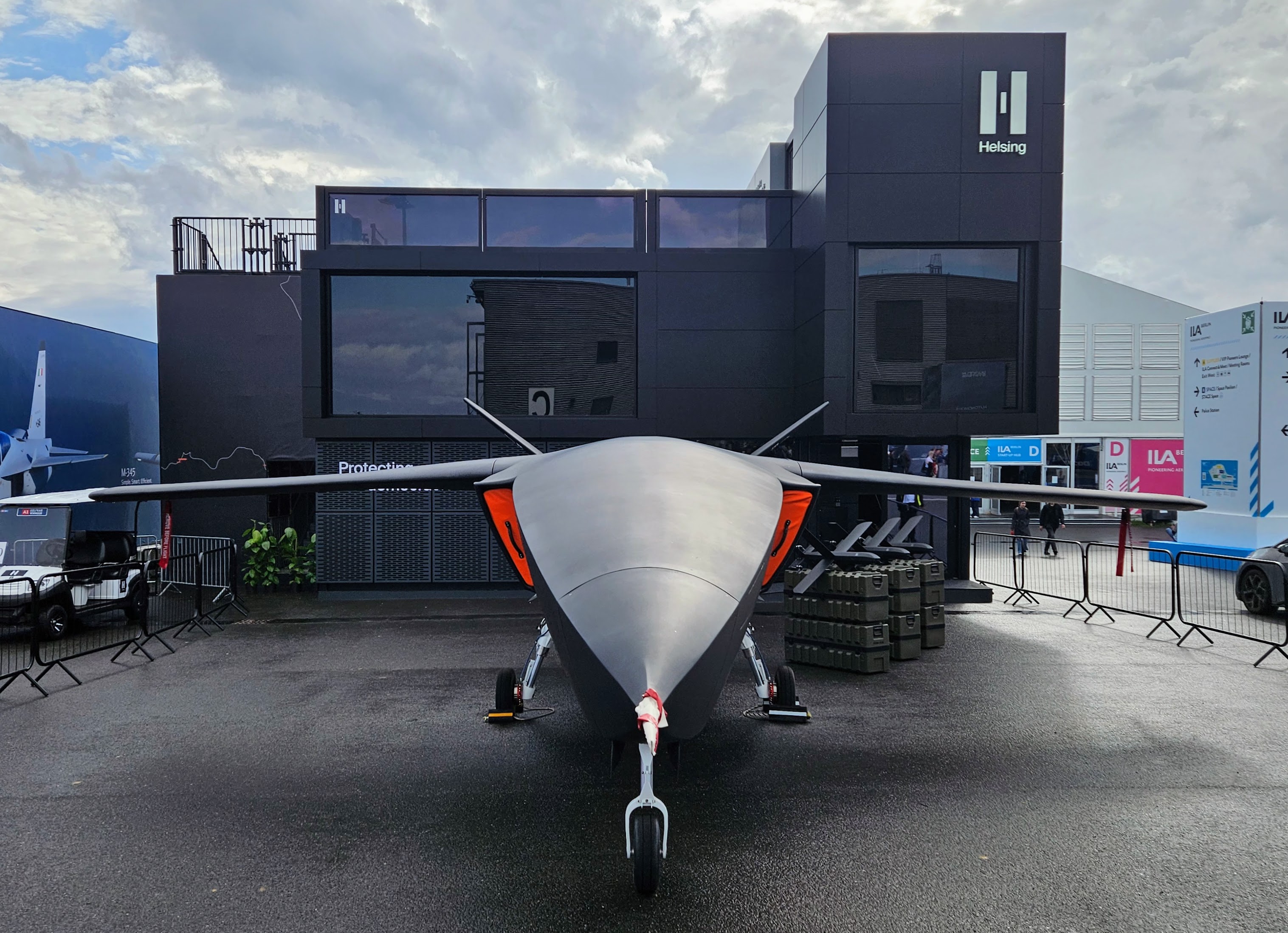
Photo: Oddlief / Wikimedia Commons, CC BY 4.0.
Videos


The CA-1 Europa is Helsing’s entry into the uncrewed-combat-aircraft race: a low-observable jet in the three-to-five-tonne class, designed from the outset to be flown by software rather than carry a pilot. Unveiled in September 2025 at Helsing’s Grob Aircraft subsidiary in Tussenhausen, Germany — where development and flight testing are based — it is pitched as a mass-producible, attritable platform that can fly deep precision strikes, ISR, and air defence either on its own or as part of a swarm escorting crewed fighters. A full-scale mock-up appeared at ILA Berlin in June 2026.
What makes the Europa a “collaborative” combat aircraft is the autonomy at its core. The aircraft is built to natively run Centaur, Helsing’s AI pilot, rather than treat autonomy as an add-on. Centaur is not a paper claim: in May and June 2025 it flew aboard a Saab Gripen E over the Baltic Sea, taking control to execute beyond-visual-range manoeuvres and issue fire commands against a human-piloted Gripen. The same stack is intended to fly the Europa, alongside Helsing’s Cirra electronic-warfare and Symphony mission-coordination systems, with sensors supplied by Hensoldt.
On numbers, Helsing describes a roughly four-tonne maximum take-off weight, an airframe around 11 metres long with a 10-metre span, high-subsonic speed, an internal weapons bay, and a modular architecture meant to take different sensors and effectors. The visual resemblance to Boeing’s MQ-28 Ghost Bat has been widely noted; the strategic pitch is European sovereignty — a continental answer to US and allied collaborative-combat-aircraft programmes, offered in particular to the UK’s Royal Air Force.
The programme is early. First flight is planned for March 2027 in an optionally-piloted configuration with a Grob test pilot, followed by autonomous flight on a European test range later that year, and a targeted service entry around 2029. In June 2026 Helsing said a dedicated electronic-attack variant is aimed at 2031. No firm orders have been announced, and the open questions are schedule and integration risk rather than the concept itself — but the Europa is among the most concrete signs that Europe’s defence-tech sector intends to build crewless combat jets of its own.
Combat experience
The CA-1 Europa is a development programme, not yet a fielded weapon — no combat record exists. It was unveiled in September 2025 at Helsing’s Grob Aircraft subsidiary in Tussenhausen, Germany, and a full-scale mock-up was shown at ILA Berlin in June 2026.
Its autonomy lineage is, however, already flight-proven. The Centaur AI pilot that will fly the Europa was demonstrated in May and June 2025 aboard a Saab Gripen E over the Baltic Sea, where it took control of the aircraft and executed beyond-visual-range manoeuvres and fire commands against a human-piloted Gripen. The Europa is designed to carry that same software natively rather than as a bolt-on.
Effectiveness
No independent effectiveness data exists for a platform that has not flown. The design intent is explicit: a jet cheap enough to build in quantity, able to absorb losses, and able to fly deep-strike, ISR, air-defence, and electronic-attack missions either alone or as a swarm escorting crewed fighters. Helsing positions it as a European-sovereign answer to collaborative-combat-aircraft programmes such as the US Air Force’s effort and Boeing’s MQ-28 Ghost Bat, which the airframe visually resembles.
Reporting frames the central question as schedule and integration risk rather than concept: first flight is not due until 2027 and service entry around 2029, with sensors from Hensoldt and mission systems (Cirra for electronic warfare, Symphony for mission coordination) still to be matured alongside Centaur.
Media
Sources
- helsing.ai/newsroom/helsing-unveils-ca-1-europa-an-autonomous-fighter-jet (2026-06-20) — Official Helsing announcement of the CA-1 Europa — confirms the three-to-five-tonne class, Centaur AI pilot, Grob Aircraft as the build/test site, and the single-asset-or-swarm concept.
- www.airforce-technology.com/projects/ca-1-europa-autonomous-fighter-jet-uk/ (2026-06-20) — Airforce Technology project profile — source of the ~11 m length, ~10 m span, ~4 t MTOW, high-subsonic speed, internal weapons bay, and RAF/UK pitch. Lists Centaur, Cirra, and Symphony.
- breakingdefense.com/2025/09/germanys-helsing-unveils-ai-enabled-ca-1-europa-ucav-targets-2029-entry-to-service/ (2026-06-20) — Breaking Defense — September 2025 unveiling at Grob in Tussenhausen; ~2029 targeted service entry.
- www.flightglobal.com/defence/helsings-ca-1-europa-ucav-to-fly-with-hensoldt-sensor-package/166305.article (2026-06-20) — FlightGlobal — March 2027 optionally-piloted first flight, autonomous flight late 2027, Hensoldt sensor package.
- www.flightglobal.com/defence/2026/06/helsing-aims-electronic-attack-version-of-ca-1-europa-at-2031-service-entry/ (2026-06-20) — FlightGlobal (June 2026) — electronic-attack variant targeted for 2031 service entry.
- www.saab.com/newsroom/press-releases/2025/saab-achieves-ai-milestone-with-gripen-e (2026-06-20) — Saab press release — Centaur AI agent flown on Gripen E over the Baltic on 28 May and 3 June 2025, executing BVR manoeuvres and fire commands against a human-piloted Gripen.
- www.twz.com/air/helsings-ca-1-drone-is-an-mq-28-ghost-bat-lookalike (2026-06-20) — The War Zone — notes the visual resemblance to Boeing's MQ-28 Ghost Bat and the collaborative-combat-aircraft framing.