DP Battery
Ukrainian developer of semi-solid lithium drone batteries rated at around 400 Wh/kg.
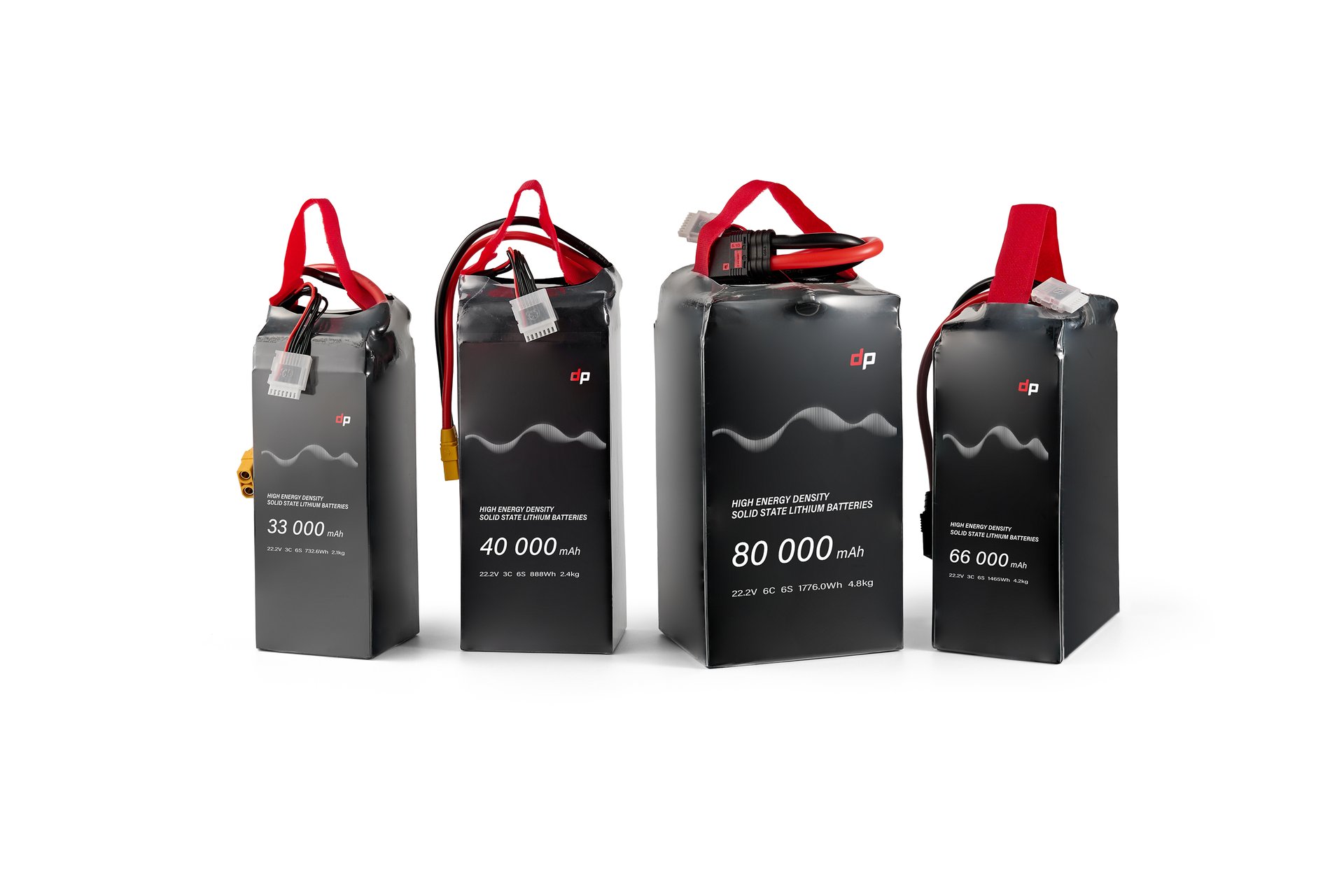
DP Battery is a Ukrainian company, led by Danylo Pavliuk, that makes semi-solid lithium battery packs for drones. The company puts the energy density of its cells at about 400 Wh/kg — by its own account roughly 1.5 to 2 times that of conventional lithium-ion packs, which it places nearer 200–240 Wh/kg. In practice that translates into either more range or more endurance for the same battery weight: the firm says an FPV drone on a 15-inch frame carrying about 1.5 kg can reach beyond 100 km, against roughly 70 km on commercial cells, while larger platforms gain up to 60 percent flight time and shed weight relative to an equivalent lithium-ion assembly.
The team came to batteries from the airframe side, having built bomber-type drones since 2022, and says it spent about three years developing and testing the cells before reaching current performance. Its own large “agrocopter”-class bomber is described as flying over 70 km with up to 80 minutes aloft. The packs entered production and were presented at the Brave1 Components conference in December 2025, an event the state defence-tech cluster Brave1 runs to spotlight domestic makers of drone parts; the company’s public presence so far is largely limited to social media.
The main trade-off is cost — semi-solid packs run roughly double the price of lithium-ion of similar capacity — and DP Battery notes the density advantage is most pronounced on larger platforms, while small packs remain limited more by how much current they can deliver than by stored energy. Domestic battery output has become a focus of Ukraine’s drive to localise drone components and reduce reliance on imported cells, a push that has drawn a wave of new Ukrainian entrants into energy storage as the war has stretched supply chains.
Products
Hardware
DP Battery semi-solid lithium pack
Semi-solid lithium drone battery rated near 400 Wh/kg, roughly 1.5-2x the energy density of conventional lithium-ion.
Gallery
Photos: defencetech.community · AndyScott · VPaleontologist · Wikimedia Commons
Sources
- militarnyi.com/en/news/batteries-with-high-energy-density-created-for-drones-in-ukraine/ (2026-06-20) — Militarnyi — CEO Danylo Pavliuk; ~400 Wh/kg; 1.5-2x lithium-ion; 15-inch FPV >100 km; agrocopter >70 km / 80 min; ~2x cost. (Direct fetch 403; corroborated via Oboronka and Militarnyi's X post.)
- oboronka.mezha.ua/en/ukrajinska-kompaniya-rozrobila-batareji-dlya-droniv-308028/ (2026-06-20) — Oboronka (Mezha) — DP Battery semi-solid lithium batteries; in production; presented at Brave1 Components conference (Dec 2025); social media as main web presence; manufacturing bombers since 2022; cost premium.
- x.com/militarnyi/status/2015893529973686388 (2026-06-20) — Militarnyi (X) — semi-solid lithium batteries with energy density 1.5-2x classic lithium-ion.