Vampire
Fixed-wing bomber UAV developed for the Ukrainian Armed Forces, carrying explosive payloads against ground targets.
Droneby Kray TechnologiesIntroduced 2023
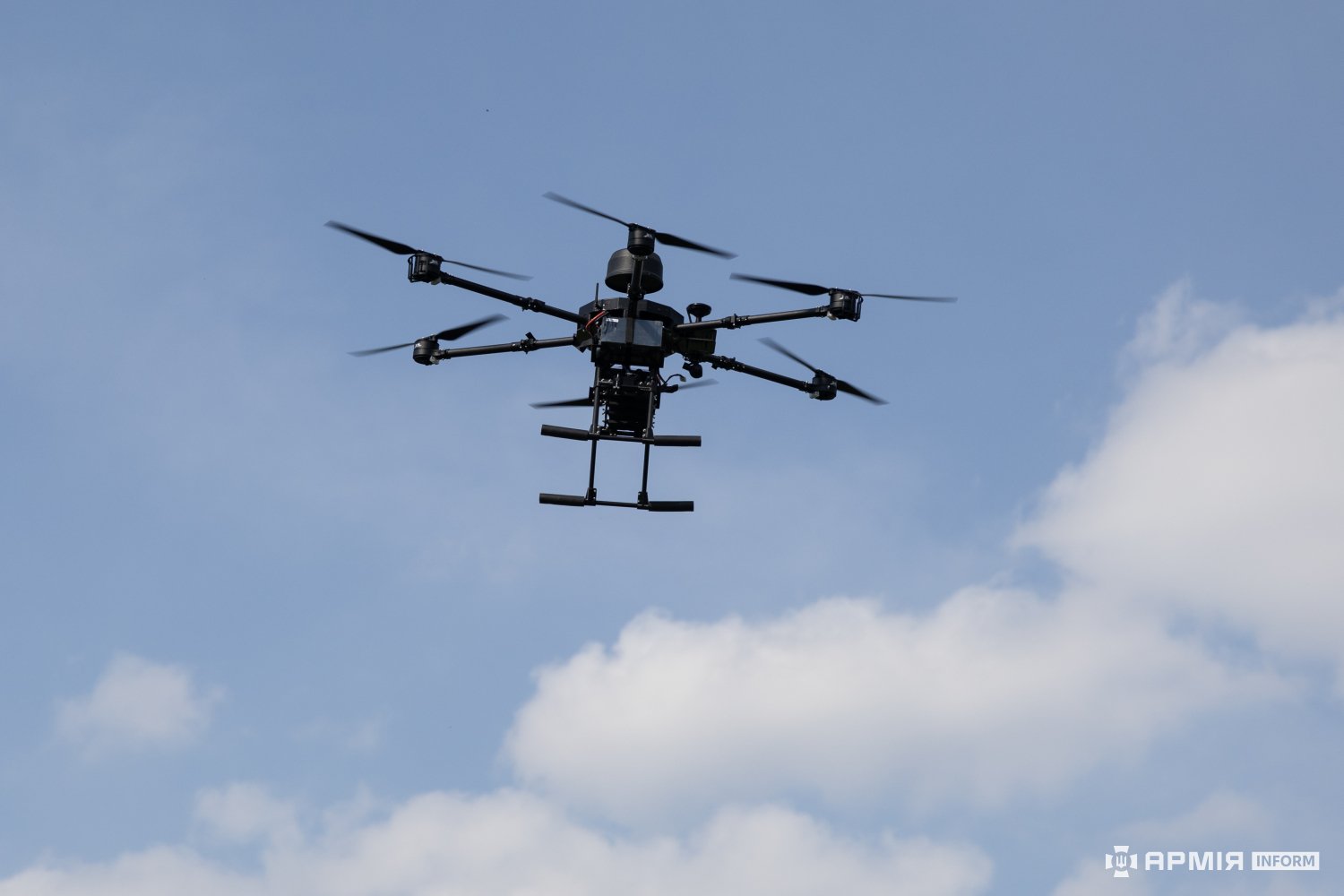
Photo: Wikipedia
Developed by Kray Technologies of Cherkasy, the Vampire is a heavy multi-rotor bomber UAV that entered widespread Ukrainian service in 2023 and has since become one of the most frequently used strike platforms on the front line. Russian troops gave it the nickname “Baba Yaga” after the folkloric witch — a label that stuck in both Russian and Ukrainian military parlance and now describes the whole category of large Ukrainian night-bomber drones. Kray began as an agricultural-drone maker whose heavy-lift hexacopters were adapted into a military bomber after the full-scale invasion.
Structurally, the Vampire is a large hexacopter with six rotors, carrying up to 15 kilograms of ordnance over a radius of around 20 kilometres according to the Ukrainian Ministry of Defence. It operates by day and night using a bispectral camera for thermal and visual targeting, and the ministry says the platform uses a proprietary GNSS antenna hardened against Russian electronic warfare, with an autonomous return mode if the control link is lost. The modular payload rack accepts a range of munitions, including TM-series anti-tank mines and PG-7 rocket-propelled grenade warheads, so operators can switch between anti-vehicle, anti-personnel, and remote mine-laying missions. The ministry puts the unit cost at around $10,000 and says basic operator training takes three hours.
The Ukrainian Armed Forces are the sole operator. The MoD states the platform has flown over a million combat sorties and credits crews with strikes on Russian electronic-warfare systems such as Borisoglebsk, counter-battery radars including Zoopark-1, and thermobaric launchers of the Solntsepyok class — a mission profile that is harder to independently verify but is consistent with observable OSINT footage of hexacopter night-drops. Beyond the strike role, Vampire crews have remotely laid minefields along infiltration routes and delivered water, food, and medical supplies to civilians cut off after the Russian destruction of the Kakhovka hydroelectric dam. The GUR’s International Legion has publicly recruited for a dedicated Vampire logistics group, which suggests a formalisation of what began as an ad-hoc capability.
The system is a visible target for both sides. Russian channels have claimed individual kills on R-18 Vampire airframes using FPV interceptors — one SolovievLive post describes a hit by a special-operations unit on the Alexandro-Kalinovsky axis using a PVC-1T FPV with a fragmentation-high-explosive charge, though such battlefield claims are difficult to verify. Ukrainian border-guard operators have in turn recovered damaged Vampires from the grey zone by lifting them home with a second drone. A Russian technical channel, UAVDEV, has described the airframe as a Chinese-origin design well-adapted to local use, a framing Ukrainian sources have not publicly engaged with. A parallel Ukrainian heavy bomber, the Pegasus Arms 25, which Russian milbloggers describe as a Vampire analog, has reportedly been struck repeatedly at its Kyiv assembly sites — which, if accurate, points to the strategic weight Russia now assigns to this class of system.
Appears in
Sources (14)
- Telegram channel, Russian side:t.me/voenkorKotenok/75586
- Telegram channel:t.me/VictoryDrones/66157
- Telegram channel, Russian side:t.me/UAVDEV/12765
- Telegram channel:t.me/tsaplienko/99192
- Telegram channel, Russian side:t.me/SolovievLive/386644
- Telegram channel, Russian side:t.me/rybar_in_english/34341
- Telegram channel, Russian side:t.me/milinfolive/180974
- Telegram channel, Russian side:t.me/milinfolive/180950
- Telegram channel:t.me/DIUkraine/9676
- Telegram channel:t.me/ButusovPlus/33751
- /osint-hetzner/2026-10-05--ukraine-deploys-ai-turrets-and-apkws-rockets-to-inter …
- /osint-hetzner/2026-08-21--ukrainian-drone-forces-strike-deep-into-russian-oil-a …
- mod.gov.ua/en/news/the-vampire-a-drone-that-terrifies-enemies-and-assists-ukrain …
- www.l3harris.com/all-capabilities/vampire