Propulsion · Turbojet engine
Telefly LX-WP-160
Also recorded as LX-WP-160
A Chinese small turbojet of the 160 kgf class, found in the Geran-4 and reported to be out of production.
- Maker
- Telefly Telecommunications Equipment Co., Limited[1]
- Country
- China
- Found in
- 1 weapon, 1 recovered unit on record
- Photos
- 1
Photos
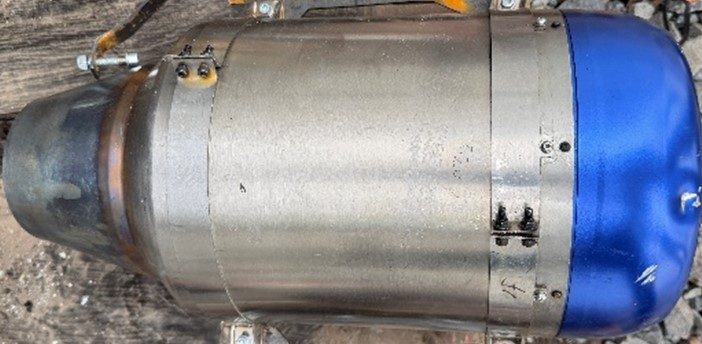
Photo: HUR War & Sanctions
The LX-WP-160 is a Telefly turbojet that HUR War & Sanctions found in a recovered Geran-4, the marking stamped on the engine itself. Euromaidan Press, reporting HUR’s release, gives it 160 kgf (1,600 N) of thrust and says it is out of production; other Geran-4s carry the larger TF-TJ2000A.
Specifications
Each figure names its source. A maker's figure is the maker's claim; nothing here was measured by us.
| Thrust | 160 kgf Claimed[2] |
|---|---|
| Production status | Out of production Claimed[2] |
What it costs
Prices published for the Telefly LX-WP-160, each in roubles, at the market rate and as the relative cost for Russia, with its source.
Reported hobby jet turbine engine (Telefly) on Geran-4 · Reported figure, 2026
- Roubles
- ₽2 million
- Dollars, market rate
- $25,000
- Dollars, imported: market price applies
- $25,000
Stated as US$25,000: Russia's Geran-4 Runs On A $25,000 Hobby Jet, Texas Instruments Chips
How the prices are worked out
Each figure is first given as its source states it. A price in dollars, yuan or euros is converted into roubles at the average market exchange rate of its year (for 2026: Bank of Russia official rate, average Jan–Sep 2026). The dollar price at the market rate is those roubles converted back, which is what the item costs someone paying in dollars.
The third price is the relative cost for Russia. Prices inside Russia are far lower than the exchange rate suggests: in 2025 a dollar fetched 83.7 roubles on the market, but 29.6 roubles bought in Russia what a dollar bought in the United States, according to the World Bank's purchasing-power-parity factor. Russian price levels were therefore about 35% of American ones, and the third price is the market-rate price scaled down by that share. It is a comparison, not money paid: it shows how much smaller the burden is when the work is paid at Russian prices, which is why a rouble budget goes about 2.8 times further than its dollar value suggests.
The factor measures prices across the whole economy, not the price of weapons. It fits Russian wages and locally made parts best. Imported parts, such as Chinese engines and radios, are paid for in hard currency, so for them the market price is the real cost and their third price equals it. A figure for a whole weapon mixes both, so its relative cost understates the imported share.
Economists who compare defence budgets make the same point. Michael Kofman and Richard Connolly put Russia's effective military spending at $150–180 billion a year at purchasing-power parity, against the roughly $60 billion a year a market-rate conversion suggests. War on the Rocks, 2019 ↗
Peter Robertson of the University of Western Australia built a price index for military spending itself and found Russia's real budget to be more than three times its market-rate value. University of Western Australia, 2021 ↗
Prices are not adjusted for inflation: each is converted at the rates of its own year, which is shown with it. Sources for the rates: World Bank, official exchange rate (LCU per US$, period average), World Bank, PPP conversion factor, GDP (LCU per international $), Bank of Russia, official exchange rates.
How it is marked
- LX-WP-160[1]
Used in
Sources
- HUR War & Sanctions war-sanctions.gur.gov.ua/en/components/7187
- Euromaidan Press euromaidanpress.com/2026/05/25/ukrainian-intelligence-russias-new-jet-powered-ge …
Last checked 2026-10-19.