Russian strike drone · deep dive
Geran-5: inside Russia's jet strike drone
Everything public about the fastest of Russia's Geran attack drones — airframe, engine, navigation, datalinks and mesh networking, onboard computers, warheads, variants, how defenders bring it down, and the photos and footage that show it best.
At a glance
- airframe
- Carbon-fibre skin, wings and tail; aluminium-profile and steel load-bearing structure (HUR)
- ceiling
- up to 6,000 m; recorded combat use 200 m to 3 km (HUR via ArmyInform)
- datalink
- Xingkay Tech XK-F358 mesh modem; Borscht Tracker V3 with 3G/LTE modems
- endurance
- up to 2 h (HUR)
- engine installation
- Initially in an external dorsal nacelle; relocated inside the fuselage on later examples (Militarnyi assessment, Sept 2026)
- guidance navigation
- Kometa-M12 jam-resistant GNSS with 12-element CRP antenna + MINSOO V3 inertial unit; claimed "Susanin" optical terrain-correlation correction on the K5 version
- launch
- Ground launcher of ~80 m (Tsymbulova, Oryol Oblast); air launch from Su-25 under study (HUR)
- length
- 6.5 m (HUR War & Sanctions); "about 6 m" in other reporting
- max takeoff weight
- 850 kg (HUR)
- propulsion
- Telefly TF-TJ2000A turbojet, 200 kgf (1,960 N), Chinese; plus a launch (booster) engine (HUR)
- range
- ~950 km (HUR War & Sanctions); ~1,000 km in other HUR-attributed reporting
- speed
- 450-600 km/h cruise (HUR)
- type
- Jet-powered one-way attack drone / low-cost cruise missile ("missile-drone")
- unit cost
- ~$115,000 claimed, of which ~$40,000 for the imported turbojet (Kyiv Independent)
- warhead
- BCh-90, ~90 kg (HUR)
- wingspan
- 3.2 m (HUR War & Sanctions); "up to 5.5 m" in Militarnyi/HUR-attributed reporting (unresolved)
Overview
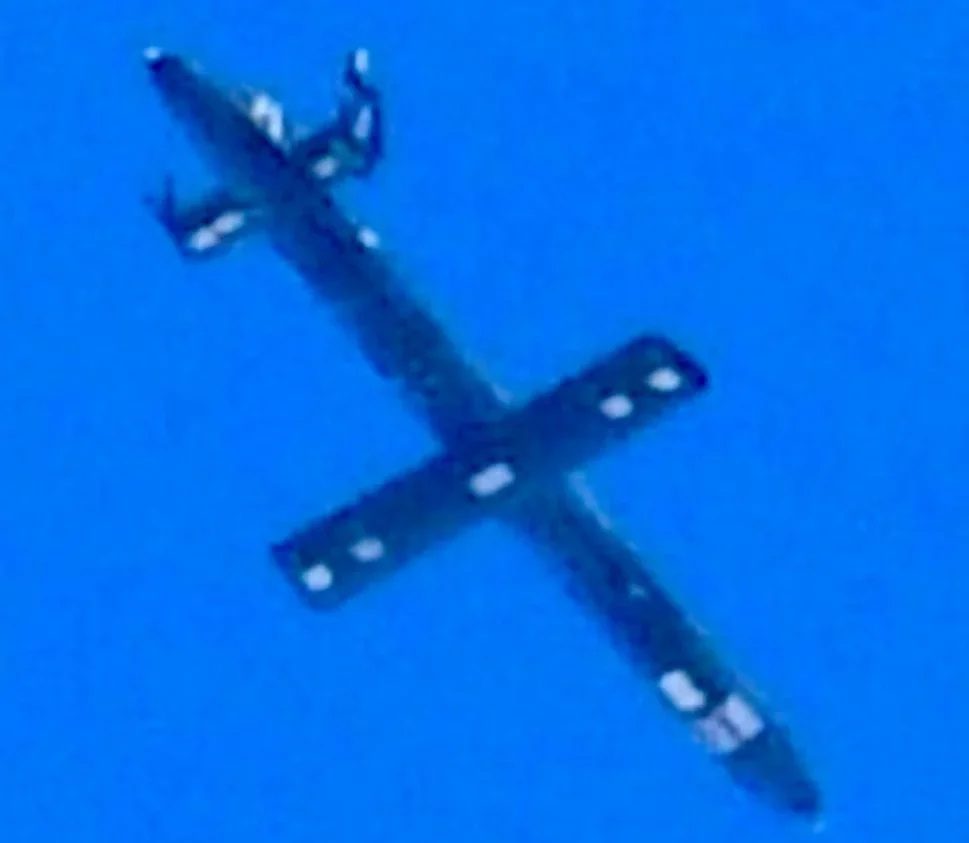
The Geran-5 is a jet-powered one-way attack drone built by Alabuga in Tatarstan. It shares a name with the Geran-2, Russia’s licensed copy of Iran’s Shahed-136, but very little of that drone’s shape. Instead of a delta wing it has a tubular fuselage, a straight mid-mounted wing and a tail with small end plates. Ukrainian analysts at Militarnyi and Defense Express call it a small cruise missile or “missile-drone”, the same class as the low-cost cruise missiles now being built in the West.
Ukraine’s military intelligence agency, HUR, reported its first combat use in early January 2026 (Ukrainska Pravda). On 19 January it published the wreckage, a 3D model and a component list on its War & Sanctions portal. The headline figures there are a length of 6.5 m, a wingspan of 3.2 m, a maximum take-off weight of 850 kg, a 90 kg warhead, a cruise speed of 450–600 km/h, a range of 950 km, about two hours’ endurance and a ceiling of 6,000 m. HUR’s verdict, quoted by The War Zone, was that “it is difficult to consider this UAV an in-house development of the Russian Federation.”
By August 2026 HUR told Militarnyi that Russia was building about 3,000 Geran-4 and Geran-5 drones a month at Alabuga and had stopped making the Geran-3. It put Geran-2 output at about 2,800 a month, so the jet types had overtaken the piston Shahed copy; Militarnyi reads this as capacity moved over from the Geran-2 lines. HUR’s deputy chief, Maj. Gen. Vadym Skibitskyi, told RBC-Ukraine that Russia was trying to make its own turbojets but was still “completely dependent” on Chinese engines costing about $35,000–40,000 each, and that it briefly cut output in July while it switched the lines to the Geran-4 and Geran-5. Russia’s two jet types now account for a large share of each attack, and in some daytime raids for two-thirds of the drones launched (Kyiv Independent).
Design and propulsion
The design draws on Iran’s Karrar target-and-strike drone, which is itself widely seen as a derivative of the American MQM-107 Streaker (Defense Express). HUR says the wing layout was copied, though the wing shape differs slightly. According to HUR, as reported by ArmyInform, the skin, wings and tail are carbon fibre over a load-bearing frame of aluminium profiles and steel.
The engine is a Chinese Telefly TF-TJ2000A turbojet rated at 200 kgf (1,960 N), listed by HUR with the maker Telefly Telecommunications Equipment Co. Early Ukrainian accounts relayed by The War Zone named a smaller Telefly JT80. HUR’s later component list settles on the TF-TJ2000A, and the same engine has since turned up in some Geran-4 airframes. HUR also lists a separate launch engine. The drone leaves the ground from a rail launcher about 80 m long, roughly three times the size of a Geran-2 launcher. Satellite imagery published by the Telegram channel Strategic Aviation of the Russian Federation shows these launchers at the Tsymbulova drone base in Oryol Oblast. Russia showed the same launcher in its “virtual” Victory Day parade on 9 May 2026. Images of 29 September from the same channel (Telegram, reported by Militarnyi) show Tsymbulova growing fast: a new pad with eight dome shelters for jet drones and another launcher, room for six more Geran-5 launch positions, new drone garages and shelters moved underground. Drones left in the open fell from nearly 100 to about 10. In October the anonymous Ukrainian OSINT channel Absolutely Reliable Source published satellite images of what it says is a new Geran-5 launch site near Millerovo in Rostov Oblast, close to the Luhansk border (Telegram). A field that was empty on 1 September showed at least eight prepared launcher positions and 32 drone-preparation areas by 12 October, with drones being unloaded. Militarnyi puts the build time at about six weeks. The images have not been independently verified.
On the first examples the engine sat in an external nacelle on top of the fuselage. In September 2026 Militarnyi studied interceptor footage released by the SBU and the Wild Hornets group and concluded that the engine had been moved inside the rear fuselage. That would cut drag and the nose-down pitching moment of a high thrust line, at the cost of internal volume that could otherwise hold fuel. Ukrainian commentators have read the change as a push towards 600–700 km/h. This is an assessment from imagery, not an official finding.
The figures are not fully settled. HUR’s portal gives a 3.2 m wingspan, while Militarnyi and other outlets citing Ukrainian intelligence give “up to 5.5 m”. Range appears as 950 km on the portal and “about 1,000 km” elsewhere. The Kyiv Independent puts the unit cost at about $115,000, with the imported turbojet alone at around $40,000. A Russian war correspondent, Dmitry Steshin, claimed in Komsomolskaya Pravda that the jet Gerans cost $60,000–75,000 in mass production; that figure is unverified.
Electronics and navigation
HUR’s teardown found that most of the avionics are the same modules used across Alabuga’s Geran family. Every part, with its markings, maker and photos, is on the Geran-5 parts list.
- Kometa-M12, a jam-resistant satellite navigation system with a 12-element controlled reception pattern antenna (CRPA). HUR attributes it to the Russian firm VNIIR-Progress, with Pantes, PSB Technologies and Aviv Group named as involved companies (HUR).
- MINSOO V3 inertial navigation unit, which HUR describes as “probably SADRA MINSO type” (HUR).
- A flight controller unit (FCU), an air data unit, servo drives, a power distribution unit and a Li-ion 18650 battery pack.
The 16 foreign components HUR identified come from the United States, China and Germany. The flight controller and power unit each carry a Texas Instruments TMS320F28335 digital signal processor. Alongside them are a TI CAN transceiver (VP230 marking), a TI hex inverter, a TI voltage regulator, a TI LM258 op-amp, an Infineon power MOSFET and a Monolithic Power Systems step-down converter. Two CTS 50 MHz clock generators are dated 2024 and week 38 of 2025. China supplied a WCH CH343G USB-to-UART bridge and a Yantel PD150 RF power divider (HUR). The 2025 date code matters to sanctions enforcement. As DroneXL put it, it shows the flow of Western parts is live rather than old stock.
Datalink, video and mesh
The Geran-5 carries the Geran family’s “Borscht” Tracker V3, a Raspberry Pi microcomputer with 3G/LTE modems and external cellular antennas that reports the drone’s position over mobile networks. It also carries a Chinese Xingkay Tech XK-F358 mesh modem (HUR). Business Insider, cited by DroneXL, gave its retail price as about $8,100.
The mesh modem lets drones in the same wave relay control and video for one another, which extends the reach of a human operator well beyond line of sight. On 27 September 2026 Serhii “Flash” Beskrestnov, adviser to Ukraine’s defence ministry, described how this worked in practice (Telegram). A Geran-5 struck the Inkom business centre in Kyiv while a jet Shahed circled at almost 3 km, relaying the Geran-5’s radio signals and filming the strike live. That second drone then flew on and hit a warehouse outside the city. Whether hidden relays inside Kyiv do the same job is a separate claim; what is known and what is not is set out in Relays over Kyiv.
Software and onboard AI
No firmware, operating system or open-source autopilot has been published for the Geran-5. HUR’s record of its flight controller, marked “Г5”, shows a TMS320F28335 processor and a CH343G USB-to-serial bridge (HUR). The tracker is visibly a Raspberry Pi wired to two USB 3G/LTE modems with SIM slots (HUR); on earlier Gerans, Serhii Beskrestnov says, such trackers report through Telegram bots. What runs on the Raspberry Pi is not public. The full comparison across the family is on the Geran-2 and Geran-4 pages.
The open question is navigation autonomy. In late September 2026 the Ukrainian monitoring channel Colonel GSh reported a Geran-5 K5 with a new fuselage and an OEKS (DSMAC-class) module. Such a module navigates by matching camera images of the ground against stored reference imagery, as the Kh-101 cruise missile does. The channel quoted a Russian war correspondent, Andrei Filatov, saying jet Gerans now use an autonomous optical system called “Susanin” that keeps them on route without satellite navigation or contact with the operator. Militarnyi stressed that the K5 name and the DSMAC-class module were not officially confirmed. A photo from the same channel shows a label on a recovered unit reading “Блок FCU Г5 K5-K Сусанин” (FCU unit, G5, K5-K, Susanin); HUR’s record of the first Geran-5’s flight controller carries the marking “Г5”.
On 5 October HUR described an “electro-optical correlation system” called Susanin on an updated Geran-4. According to Interfax-Ukraine, HUR added that a similar system is used on the “new Geran-5 K5”. Citing Defense Express, UNITED24 Media notes the consequence: such a drone does not need a constant mesh link to reach its target. HUR’s Geran-5 component page, last updated in January, still lists no optical correlation unit. On 10 October Serhii Beskrestnov wrote that a similar system, built around the “Susanin” flight controller, had recently been found on the Geran-4 and the Geran-5; he expects optical navigation to spread to cheap cruise missiles and longer-range drones next year (Telegram).
Warheads
HUR lists one warhead, the BCh-90, at about 90 kg (HUR). Its filling is not specified. That is the same mass class as the largest Geran-2 and Geran-4 warheads, and small next to the 480 kg of an Iskander-K or the up to 800 kg of a Kh-101 (Kyiv Independent). The Wild Hornets group has said the Geran-5 carries a larger charge than other Gerans, which The War Zone could not verify.
Variants
- First configuration (January 2026), with the engine in an external pod above the fuselage. Some reporting calls it an “E” or “Э” series; that label belongs to the Geran-2 E series, not to the Geran-5.
- Internal-engine version (reported September 2026), inferred from interceptor footage (Militarnyi).
- Geran-5 K5 (reported late September 2026), with a modified fuselage and the claimed Susanin optical correction (Colonel GSh).
- Air-launched version, under study. In January HUR said Russia was looking at launching the Geran-5 from Su-25 attack aircraft. Published diagrams show two drones under the wings, but no air launch has been confirmed (The War Zone).
- R-73-armed version, planned. Following Iran’s Karrar, which has carried an Azarakhsh missile, Russia is reported to be considering an R-73 infrared air-to-air missile for self-defence (Defense Express). No wreckage has shown one.
Combat use
After its January debut the Geran-5 was rarely filmed. In August 2026 the Russian channel Military Informant called footage of Geran-5 strikes “quite rare”. It credited the 50th unmanned systems brigade “Varyag” with hits on a Nova Poshta logistics hub and fuel depot in Novhorod-Siverskyi and on a gas compressor station, all Russian claims. Use rose sharply in September. Ukraine’s Air Force reported that on the night of 28 September Russia launched 165 attack drones, 79 of them jets (Air Force of Ukraine). That day a fast drone diving at a steep angle set the Presidium of the National Academy of Sciences in central Kyiv on fire, killing two people (Al Jazeera). The Kyiv Independent attributes the strike to a Geran-5. Russian channels have also claimed Geran-5 strikes on data centres and telecom nodes in Kyiv and Dnipro. On 29 September the Strategic Aviation channel estimated that the Geran-5 had grown from about 10% to about 75% of the drones launched at Kyiv in a month (UNITED24 Media); that is the channel’s estimate, not an official figure.
On 2 October 2026 Putin was shown both jet Gerans at the Centre-2026 exercise at the Chebarkul range in Chelyabinsk region. Ukrainian OSINT researchers at Evocation.info identified the presenter as Ildar Tazutdinov, an Alabuga executive whose role there the US government has documented (UNITED24 Media). The figures given for the Geran-5 at the display were up to 450 km/h, a 90 kg warhead and about 900 km range, below HUR’s 450–600 km/h and 950 km.
Countering it
The Geran-5 is the hardest Geran to stop. A senior defence engineer told the Kyiv Independent that it flies about 150 km/h faster than the Geran-4. As a result, interceptors have to engage it from the front instead of chasing it, “a much harder problem to solve.” Mobile fire groups and the cheap interceptor drones that defeated piston Shaheds are no longer enough. In September 2026 President Zelensky put Ukraine’s rate against all jet drones at about 55% of more than 2,730 launched, against over 90% for piston types (UNITED24 Media). Air Force spokesman Yurii Ihnat gave the Financial Times a similar picture in mid-September: about 60% of the new jet drones intercepted, against 90–95% for other types (LIGA). Single nights swing widely. On 7 October the Air Force reported 38 of 46 jet drones downed or suppressed, about 83% (Militarnyi), and officials reported 77% on the night of 13–14 October (Defense News). These figures cover all the jet Gerans, not the Geran-5 alone.
On 6 October the deputy Air Force commander, Col. Yurii Cherevashenko, told a parliamentary inquiry that Ukraine expected Russia to raise jet-drone speeds to 800–900 km/h, though no such speed had been recorded and the jets then flew at up to 600 km/h (TSN). Jets were about 40% of Russia’s drones, up to 60% on some axes, and the Air Force expected 80%. About 20 companies were working with the Air Force on jet interceptors; 14 were flight-testing, six had some kills and three had promising results. He did not expect deliveries at the needed scale before the end of November. He spoke of jet drones in general, not the Geran-5 by name. Ten days later the Russian blogger Yurii Podolyaka claimed that on the night of 16 October Geran-5s had switched to a boosted engine mode to outrun interceptors and reached 700–800 km/h (EADaily). He showed no evidence, and it sits against the Air Force’s statement that nothing above 600 km/h had been recorded.
Purpose-built interceptors have started to score, so far in small numbers. In September a crew from the 1020th Anti-Aircraft Missile Regiment used a Wild Hornets STING S to bring down a Geran-5 over Chernihiv Oblast at 425 km/h and above 3 km (Euromaidan Press). SkyFall’s P1-SUN Jetkiller, Quantum WIY’s SPYS (a propeller interceptor that can sprint to 600 km/h briefly) and an SBU delta-wing jet interceptor have also downed Geran-5s. Serhiy Sternenko, a drone-warfare adviser, said “there is currently no mass produced effective product”.
More kills followed, all claimed by the units or developers with video and none independently verified. The P1-SUN JetKiller kills were made by crews of Lasar’s Group, a National Guard drone unit, with a second Geran-5 destroyed on 2–3 October after the first on 30 September; the onboard video shows a head-on pass (Militarnyi). On 12 October former defence minister Mykhailo Fedorov said a new, unnamed interceptor had shot down two Geran-5s heading for Kyiv, its first combat results. His team and Lasar’s Group commander Pavlo Yelyzarov developed it in about a month, and the aim is a fully autonomous version (Interfax-Ukraine). On 8 October the “Spalakh” crew of the 1020th Anti-Aircraft Missile and Artillery Brigade used a jet interceptor supplied by the Serhiy Prytula Foundation to bring down a Geran-5 over Chernihiv region, flying at about 430 km/h at only 780 m. It was the brigade’s second such kill; the interceptor model was not named (UNITED24 Media). Earlier, on 23 September, the State Border Guard Service released footage of a Geran-5 brought down by its 105th Border Detachment, without saying how, and another had come down over Kyiv’s Holosiivskyi district in early September (UNITED24 Media).
Gun turrets have joined in. On 5 October Air Force spokesman Yurii Ihnat said the AI-aimed turrets around Kyiv had already shot down jet drones, Geran-5s among them (Ukrainska Pravda). Machine vision aims their heavy machine guns, which also limits their range; he gave no kill count. President Zelensky had said a day earlier that more than 12 turrets were in place in Kyiv and eight more were coming to Kyiv Oblast. UNITED24 Media names the system Sky Sentinel, with .50-calibre guns, and Ihnat put the overall interception rate against jet drones at about 50–70% (UNITED24 Media). A Russian channel argues that a reach of roughly 1.5 km leaves only seconds against a target this fast (Military Informant).
The fastest interceptors depend on their own datalink. On the night of 13–14 October Ukrainian forces found Starshield, the military service of Starlink, restricted: soldiers said the connection dropped when moving faster than about 160 km/h and that several missions were disrupted. Serhii Beskrestnov called the Starlink-linked interceptors “the most effective solution” Ukraine currently has against jet Shaheds (Ukrainska Pravda). President Zelensky said that when the speed was reduced, some jet Shaheds could not be intercepted (Ukrainska Pravda); in another statement he said the link was lost completely about two minutes after passing 161 km/h, and only inside Ukraine (Militarnyi). Who ordered the restriction is disputed: Reuters reported that it came from the White House, while Axios reported that the administration had no part in it. By 16 October Zelensky said the defence ministry had been told the speed was restored. The statements speak of jet Shaheds in general, not the Geran-5 by name.
Electronic warfare has limits against this drone. The Kometa-M12’s 12-element CRPA is designed to resist GNSS jamming, and the reported Susanin optical correction would further reduce reliance on satellite signals and on the operator link. Two other points for defenders come from Militarnyi’s analysis. Moving the engine inside the fuselage may lower the infrared signature from the front and sides, though the exhaust plume remains the main IR source. The drone’s speed also gets it mistaken for jet missiles such as Ukraine’s Dan-T. Further back in the chain, Ukraine has struck VNIIR-Progress, the Kometa maker, with an FP-5 Flamingo missile, and the jet launch sites at Tsymbulova and Donetsk airport have been located from satellite imagery. Analyst Fabian Hoffmann told the Kyiv Independent the biggest weakness is that “Russia is not yet able to mass produce the engine on its own”.
What remains unknown
- Whether the K5 and its Susanin optical correction are a separate production version, a retrofit, or a module shared with the autumn 2026 Geran-4. HUR has not published a Geran-5 K5 component list.
- Whether the localised Russian turbojet that HUR reports in the newest Geran-4 has reached the Geran-5.
- The true wingspan (3.2 m or up to 5.5 m) and the warhead filling.
- Whether the Geran-5 is still launched only from fixed ground rails, or also from aircraft as HUR suggested.
- How many Geran-5s are built, as opposed to the combined Geran-4/5 figure of about 3,000 a month.
- Whether any Geran-5 has flown faster than 600 km/h. A Russian blogger claimed 700–800 km/h on 16 October 2026; Ukraine’s Air Force had recorded nothing above 600 km/h as of 6 October.
Warhead upgrades
| Warhead | Type | Mass | Since | Notes |
|---|---|---|---|---|
| BCh-90 | Not specified by HUR (high-explosive class) | ~90 kg | 2026-01 | The only warhead HUR lists for the Geran-5; same mass class as the largest Geran-2/Geran-4 warheads source |
Variants
- Geran-5, first configuration (external engine pod) 2026-01
Turbojet in a pod above the rear fuselage with a top intake; Kometa-M12, MINSOO V3, Borscht tracker and XK-F358 mesh modem (HUR, January 2026). Some reporting calls it an "E" or "Э" series; that label belongs to the Geran-2 E series with MANPADS, not to the Geran-5. source
- Internal-engine configuration 2026-09
Turbojet moved from the external pod into the rear fuselage: less drag and a higher top speed (expert estimates 600-700+ km/h), possibly at the cost of range. Seen in SBU and Wild Hornets interceptor footage (Militarnyi, 19 September 2026); the Geran-5 K5 carries this airframe. source
- Geran-5 K5 2026-09
New fuselage with the engine inside, and Susanin optical navigation that matches camera images against stored ones so it can fly without satellite signals. The name came from a Ukrainian monitoring channel; HUR was then quoted using it (5 October 2026), but HUR's Geran-5 component list does not show the optical unit yet. source
- Air-launched (Su-25)
HUR said in January 2026 that Russia is studying launch from Su-25 attack aircraft; diagrams show two drones underwing; no confirmed air launch source
- R-73-armed (planned)
Russia reportedly considering an R-73 air-to-air missile for self-defence, as tested on Geran-2 with R-60; not seen in wreckage source
Countering it
What defenders and analysts report publicly; each line links its source.
- Purpose-built fast interceptor drones — Wild Hornets STING S (1020th AA Missile Regiment kill over Chernihiv Oblast at 425 km/h and above 3 km, Sept 2026), SkyFall P1-SUN Jetkiller, Quantum WIY SPYS (brief 600 km/h sprint) and an SBU delta-wing jet interceptor have each downed small numbers; no mass-produced effective product yet (Sternenko). Later claims - SkyFall and the unit, Fedorov, the Prytula Foundation, video released, not independently verified - add to this. Lasar's Group (National Guard) made the P1-SUN kills on 30 Sept and 2-3 Oct, the second head-on (Militarnyi). On 12 Oct Mykhailo Fedorov said a new, unnamed interceptor built by his team and Lasar's Group commander Pavlo Yelyzarov in about a month had downed two Geran-5s heading for Kyiv; a fully autonomous version is the aim (Interfax-Ukraine). On 8 Oct the 1020th brigade's "Spalakh" crew downed a Geran-5 over Chernihiv region at ~430 km/h and 780 m with a jet interceptor from the Serhiy Prytula Foundation, its second such kill (UNITED24 Media). The Border Guard's 105th detachment released footage of a Geran-5 brought down on 23 Sept, means not stated. source
- Jet-interceptor programme (Air Force) — On 6 Oct 2026 deputy Air Force commander Col. Yurii Cherevashenko told a parliamentary inquiry that about 20 companies were working on jet interceptors with the Air Force, 14 of them flight-testing, six with some kills and three with promising results; deliveries at the needed scale were not expected before the end of November. Jet drones were ~40% of Russia's drones (up to 60% on some axes), forecast to reach 80%. He said Ukraine expected Russia to raise jet-drone speeds to 800-900 km/h, though none above 600 km/h had been recorded. A Russian blogger's claim that Geran-5s reached 700-800 km/h on 16 Oct came without evidence. source
- Interceptor datalink limits — In mid-October 2026 President Zelensky said the fastest interceptors against jet Shaheds are controlled over Starlink, and that when terminal speeds were capped some jet drones could not be intercepted; outlets give different thresholds (70, ~160, 161 km/h). Who set the cap is disputed. Statements cover jet Shaheds in general, not the Geran-5 by name. source
- Head-on engagement geometry — Interceptors must engage from the front rather than chase from behind, described by a defence engineer as "a much harder problem" source
- Overall jet-drone interception rate — About 55% of 2,730+ jet drones neutralised in September 2026 (shot down or electronically suppressed), versus >90% for piston Shaheds. Air Force spokesman Yurii Ihnat told the Financial Times in mid-September that about 60% of the new jet drones were intercepted against 90-95% for other types, and in October put the jet rate at about 50-70%. Single nights vary widely - 38 of 46 jet drones (~83%) on 7 Oct (Militarnyi), 77% of jet drones on the night of 13-14 Oct (Defense News). All figures cover the jet Gerans together. source
- Electronic warfare limits — Kometa-M12 uses a 12-element CRP antenna to resist GNSS jamming; the reported Susanin optical correction is designed to reduce dependence on satellite signals and the operator link (Defense Express via UNITED24) source
- Infrared signature — Moving the engine inside the fuselage may cut forward and side IR contrast; the exhaust nozzle and plume remain the main IR sources source
- Identification — Its speed causes it to be confused with jet missiles such as Dan-T (Ukrainian monitoring channel) source
- Relay aircraft as a node — In the 27 Sept 2026 Kyiv strike a separate jet Shahed at ~3 km provided the mesh relay and filmed the hit source
- Striking the supply chain and launch sites — Ukraine struck Kometa antenna maker VNIIR-Progress with an FP-5 Flamingo; launch sites at Tsymbulova and Donetsk airport identified from satellite imagery. Imagery of 29 Sept 2026 (Strategic Aviation) shows Tsymbulova expanded with dome shelters, new launchers and room for six more Geran-5 launch positions, shelters moved underground and open-air storage cut from ~100 drones to ~10 - a harder target. In October an anonymous OSINT channel published imagery of a new Geran-5 site near Millerovo (Rostov Oblast), a bare field on 1 Sept with 8 launcher positions and 32 preparation areas by 12 Oct (claim; Militarnyi, Euromaidan Press relay it). source
- AI-controlled gun turrets — On 5 Oct 2026 Air Force spokesman Yurii Ihnat said AI-aimed gun turrets around Kyiv had shot down jet drones, Geran-5s among them; machine vision aims heavy machine guns, which also limits their range. No kill count was given. Zelensky said on 4 Oct that more than 12 turrets were in place in Kyiv, with eight more due in Kyiv Oblast; UNITED24 Media names the system Sky Sentinel (12.7 mm). A Russian channel argues a ~1.5 km reach leaves only seconds against a 400-500 km/h target (milinfolive, 4 Oct). source
The Geran family side by side
| Geran-2 | Geran-3 | Geran-4 | Geran-5 | Geran-5 K5 | |
|---|---|---|---|---|---|
| propulsion | — | — | Telefly LX-WP-160 (160 kgf) or Telefly TF-TJ2000A (200 kgf) turbojet, Chinese; autumn 2026 version uses a localised Russian-built equivalent made at Alabuga (HUR) | Telefly TF-TJ2000A turbojet, 200 kgf (1,960 N), Chinese; plus a launch (booster) engine (HUR) | Turbojet inside the rear fuselage, with an intake on top (Geran-5 used an external pod) |
| engine | MD-550 piston engine, reverse-engineered from the German Limbach L550E 550 cc four-cylinder two-stroke (Wikipedia) | Telefly JT80 turbojet (China) on the "U" series examined by HUR; some sources say Iranian Tolou-10/13 turbojets are also used | — | — | — |
| speed | — | — | Cruise 320 km/h, max 450 km/h (HUR War & Sanctions); manoeuvring 300-400 km/h and up to 500 km/h (HUR, May 2026); 450-500 km/h observed (RFE/RL) | 450-600 km/h cruise (HUR) | Faster than the standard Geran-5 and Geran-4 (Colonel GSh); expert estimates for the internal-engine airframe 600-700+ km/h |
| range | up to ~2,500 km quoted for the baseline airframe; reduced to roughly 650 km with the 90 kg warhead and a smaller fuel load, per leaked documents (Wikipedia) | up to ~1,000 km (HUR estimate); Militarnyi gives ~600 km; presidential adviser Serhii Beskrestnov says flights of about 300–350 km were observed | 770 km (HUR War & Sanctions); up to 450 km (HUR, May 2026); >700 km Crimea-Lutsk flight reported (RFE/RL) | ~950 km (HUR War & Sanctions); ~1,000 km in other HUR-attributed reporting | — |
| warhead | ~50 kg standard; ~90 kg BCh-90 option tested from late 2023 (ISIS, May 2024) | ~50 kg; CSIS notes payloads up to 90 kg on some Russian variants | 50 kg (OFBCh-50 HE-frag, TBBCh-50M thermobaric, ZBBCh-50 incendiary + OFBCh-2), 90 kg TBBCh-90 thermobaric, KRSN cumulative-cutting load (HUR) | BCh-90, ~90 kg (HUR) | Not separately reported; Geran-5 carries the 90 kg BCh-90 |
| navigation | inertial unit plus GNSS through the Russian 12-channel jam-resistant "Kometa" CRPA module (HUR, December 2025); some versions add camera feed over cellular, Starlink or mesh links | inertial unit (SADRA), air-pressure unit and the Kometa-M12 12-element adaptive antenna array (HUR, Militarnyi) | — | — | Satellite (anti-jam CRPA) and inertial, plus "Susanin" electro-optical terrain correlation (OEKS / DSMAC class) that compares camera images with stored reference images |
| datalink | — | — | Xingkay Tech mesh modem (claimed 300 km, relays for other drones), two GSM modems with foreign SIM cards, Borscht Tracker V3 | Xingkay Tech XK-F358 mesh modem; Borscht Tracker V3 with 3G/LTE modems | — |
| launch | rail or ramp with a rocket booster, including truck-mounted launchers | rail/ramp launch with booster, as for the Shahed family; new launch sites reported in occupied Donetsk | — | Ground launcher of ~80 m (Tsymbulova, Oryol Oblast); air launch from Su-25 under study (HUR) | — |
| unit cost | about $35,000 to produce, per CSIS estimates cited by Reuters (2026); RUSI earlier gave $30,000–80,000; the 2023 Iran–Alabuga contract priced units near $193,000 | not published; Russian interest in Iranian Shahed-238s was reported at $0.9–1.4 million per unit, depending on variant (CSIS) | $50,000-70,000 claimed (air-defence source to The Economist, via UNITED24); engine $35,000-40,000 (HUR) | ~$115,000 claimed, of which ~$40,000 for the imported turbojet (Kyiv Independent) | — |
From the Telegram channels
Posts this page relies on. Russian channels' statements are claims.
- Telegram channel:@serhii_flash2026-10-22
Flash reports that on 22 October 2026 Russia struck Ukraine with a new Geran-5 modification known in open sources as "Geran-5 K5-K". He says it was first recorded about a month earlier and that it features an optical navigation system, increased range, higher speed and greater flight altitude.
- Telegram channel:@Istoria_zbroi2026-10-22
Istoria Zbroi says the Geran-5 K5-K also has a modified fuselage. Some monitoring resources report increases in speed, range and altitude, but exact K5-K characteristics have not been officially published. The channel notes the turbojet-powered drone is converging in capability toward a small cruise missile.
- Telegram channel, Russian side:@Voenacher2026-10-21
Voenacher (Russian, grade C) posted on 21 Oct 2026 what it described as the moment of impact and the aftermath of a Geran-5 strike on a Metro shopping centre in Rivne, western Ukraine. Russian-channel claim; no technical detail, type attribution is the channel's.
- Telegram channel, Russian side:@barantchik2026-10-20
Barantchik reports two Geran-5 strikes on the Epicenter logistics hub in Dubno, Rivne Oblast, on 20 October 2026 — first at 11:50, second at 13:00 — both reportedly hitting the complex and starting a fire with thick black smoke, framed as part of the campaign against transport and logistics infrastructure in western Ukraine.
- Telegram channel, Russian side:@barantchik2026-10-16
Pro-Russian channel barantchik, citing monitor AMK Mapping, says some Geran-5s in the 16 October strikes reached 700-800 km/h versus the 450-600 km/h HUR assessment. He argues this closes the gap to Russian air-launched cruise missiles and shortens the window for Ukrainian air defence.
- Telegram channel, Russian side:@yurasumy2026-10-16
Ukrainian commentator yurasumy says 16 October Geran-5s cleared Ukrainian air defence after accelerating to 700-800 km/h, arguing this undercuts the 600 km/h assumption behind the new interceptor drones being mass-produced to counter the type.
- Telegram channel:@VictoryDrones2026-10-14
Ukrainian digest Victory Drones notes that the adversary is buying hundreds of STING S jet-interceptor drones at about $2,000 each specifically to shoot down jet-powered Geran-5s.
- Telegram channel, Russian side:@romanov_922026-10-14
Pro-Russian channel romanov_92 lists Geran-5 strikes on 13 October against the Shepetivka wagon depot (50.19764, 27.06460) and the Zhmerynka railway station (49.036783, 28.104820), citing Ukrainian Railways chief Pertsovskyi and NASA FIRMS as corroboration.
- Telegram channel:@absolutely_reliable2026-10-13
Satellite imagery shows a new drone port near Millerovo (Rostov Oblast) built in about a month for Geran-5 launches. The field was bare on 1 September; the first part of the site is now close to completion, with 8 prepared launcher positions and 32 drone-preparation areas, and the previous day's image shows drones being unloaded. The channel says the project was rushed to scale up attacks after th
- Telegram channel:@WarTranslated2026-10-13
WarTranslated relays that Russia built the "Millerovo" launch site to fire Geran-5s in roughly a month: nothing visible on 1 September, the first stage near completion by mid-October.
- Telegram channel:@serhii_flash2026-10-10
Expects optical navigation systems to spread next year to mid-range and deep-strike drones and cheap cruise missiles. Explains the principle: the drone carries stored images of the terrain (even Google ground imagery is enough for basic orientation) and compares them with its camera view. Russia already uses such systems on the small Molniya, V2U and Lancet drones, and a similar system built aroun
- Telegram channel:@tsaplienko2026-10-09
Via Ukrainian channel tsaplienko, Flash explains the Shahed's dual guidance: it can be flown to its target in radio-control mode through its mesh modem, or by GPS and other satellite-navigation signals. The post also reports a new 32-element CRPA antenna fitted to Shaheds to preserve the satellite fix under Ukrainian electronic-warfare jamming.
- Telegram channel, Russian side:@milinfolive2026-10-04
Reports Ukrainian statements that AI-controlled automatic turrets have been placed in Kyiv against jet Gerans. Calls this doubtful: the photographed Sky Sentinel turret with a 12.7 mm machine gun was used against slow piston Geran-2s; against 400-500 km/h Geran-4/5 a ~1.5 km range gives only seconds of engagement, fit only as last-layer point defence.
- Telegram channel, Russian side:@voenkorKotenok2026-10-04
Russian military-correspondent channel Voenkor Kotenok (4 October 2026) relays, mockingly, Flash's description of mesh repeaters of varying power that could be assembled in an ordinary house or even a suitcase and need only an internet connection and mains power to work.
- Telegram channel:@VictoryDrones2026-10-03
Beskrestnov ("Flash") insists on 3 October 2026 that Russian mesh repeaters are being switched on inside Kyiv to provide a short-term control channel for Shahed strike correction. He estimates one to three devices, says they are hard to find, and cites the SBU-headquarters strike — during which no other Shahed-borne mesh retransmitters were airborne — as his evidence.
- Telegram channel, Russian side:@barantchik2026-10-03
Russian channel Barantchik (3 October 2026) reports the Ukrainian adviser's claim that Russia has deployed its own retransmitters inside Kyiv to correct Geran strikes, estimates 1–3 such devices, and adds that they are hard to find and may be disguised as civilian objects or mobile devices.
- Telegram channel:@VictoryDrones2026-09-30
Footage of a Geran-5 over Kyiv. Claims a speed of up to 600 km/h and a relatively small radar cross-section that hamper detection and tracking, says Ukraine has practically no effective means to intercept it and that production is ramping up. Russian-side framing; the 'no effective counter' and RCS statements are claims.
- Telegram channel:@VictoryDrones2026-09-30
Victory Drones (30 September 2026) describes Geran-5 use of mesh as a new level of grouped strike coordination: drones fitted with modems pass signals to one another in a chain to hold communications under jamming, and record video of impacts for real-time damage assessment and correction of follow-up waves against Ukrainian data centres.
- Telegram channel:@StrategicaviationT2026-09-29
High-resolution satellite images of the Tsymbulova drone port (Oryol Oblast) as of 29 September show four weeks of continuous expansion: a new pad with eight dome shelters for jet drones and a new launcher, paved pads for eight more shelters and two more launchers, six finished strike-drone garages and 14 new ones along the access road, ground shelters rebuilt underground, and sites for six more G
- Telegram channel:@kpszsu2026-09-28
Overnight on 28 September (from 18:00 on 27 September) Russia attacked with 165 Shahed-type, Gerbera and Parodiya decoy drones, 79 of them jet-powered, from Oryol, Millerovo, Primorsko-Akhtarsk, Shatalovo, occupied Donetsk and Crimea (Hvardiiske). As of 07:00, 112 were shot down or suppressed; hits recorded at 14 locations.
- Telegram channel:@serhii_flash2026-09-27
Explains the strike on the Inkom business centre in Kyiv: it was a Geran-5. At the same time a jet Shahed circled the target at almost 3 km, acting as a mesh relay for the Geran-5's radio signals and filming and transmitting video of the attack in real time. That Shahed then flew outside Kyiv and destroyed a McDonald's warehouse. Flash calls it a complex operation requiring coordinated pilots, and
- Telegram channel:@war_home2026-09-27
Reports Russian use of a new Geran-5 version, the "Geran-5 K5", fitted with an OEKS (DSMAC) module that navigates by reference images of the ground, as on the Kh-101, and a new fuselage. Because it is faster than the Geran-4 and the standard Geran-5 it is often mistaken for Dan-T type missiles. Quotes a Russian journalist claiming jet Gerans now carry the autonomous optical navigation system "Susa
- Telegram channel, Russian side:@milinfolive2026-08-06
Publishes what it calls quite rare footage of Geran-5 strikes by operators of the 50th unmanned systems brigade "Varyag": a Nova Poshta logistics centre and a fuel depot in Novhorod-Siverskyi (Chernihiv Oblast) and a gas compressor station in the village of Zhabky. Russian claim, not independently verified.
- Telegram channel:@StrategicaviationT2026-04-22
Satellite imagery of the Tsymbulova drone base (Oryol Oblast) shows launchers for jet Geran-3/4 and Geran-5. A launcher for this type is about 80 m long, three times a standard UAV launcher. Tsymbulova and Donetsk airport are the only known launch sites for these jets. Many drones stand in the open; passenger cars are parked by the garages, used as another launch method; new storage buildings are
Sources
Every line on this page is attributed. Russian claims, whether from officials or milbloggers, are labelled as claims. Where sources disagree, both are shown. The parts lists come from teardowns of recovered drones published by Ukrainian intelligence, independent researchers and the press.
- Geran-5 UAV - foreign components, modules and specifications — HUR War & Sanctions 2026-01-19
- Jammer-proof satellite navigation system Kometa-M12 — HUR War & Sanctions 2026-01-19
- Inertial navigation system MINSOO V3 — HUR War & Sanctions 2026-01-19
- Launch engine — HUR War & Sanctions 2026-01-19
- Warhead BCh-90 — HUR War & Sanctions 2026-01-19
- Borscht (Tracker V3) — HUR War & Sanctions 2026-01-19
- Launch bar AV. Panel — HUR War & Sanctions 2026-01-19
- Intelligence reveals characteristics and component base of Russia's new Geran-5 UAV — ArmyInform 2026-01-19
- Russia's Jet-Powered Geran-5 Drone Can Fly 600 km/h, Carry 90 kg Warhead - HUR — Kyiv Post 2026-01-19
- Russia deploys Geran-5 strike drone in attack for first time — Ukrainska Pravda 2026-01-11
- Russia's New Geran-5 Long-Range Kamikaze Drone Could Be Air-Launched — The War Zone 2026-01-12
- Russia's Geran-5 Jet Drone Uses Western Electronics — DroneXL 2026-01-22
- Geran-5 Cruise Missile Revealed in russia for the First Time — Defense Express 2026-05-10
- Geran-5 Drones Deployed Near Oryol for Strikes on Ukraine — Militarnyi 2026-04-23
- Russia Produces Around 3,000 Geran-4/5 Kamikaze Drones per Month — Militarnyi 2026-08-12
- Geran-5 Cruise Missile Adopts a Revised Engine Configuration to Enhance Speed and Range — Militarnyi 2026-09-20
- Russian Forces Begin Using New Geran-5 Version With Autonomous Optical Navigation — Militarnyi 2026-09-27
- Geran-5 Gets Kh-101-Like Guidance — UNITED24 Media 2026-10-05
- HUR on updated Geran-4 (Susanin, MOK, KRSN, localized engine) — Interfax-Ukraine 2026-10-05
- Ukraine's interceptor tech outpaced by Russia's jet-powered Geran-5 drones — Kyiv Independent 2026-10-01
- Russia's Jet-Powered Shahed Drones Are Quickly Evolving As Ukraine Scrambles To Blunt Their Damage — The War Zone 2026-09-29
- Ukraine just caught a Geran-5 at 425 km/h — Euromaidan Press 2026-09-29
- Ukraine now neutralizes 55% of Russia's jet-powered Shahed drones, Zelenskyy says — UNITED24 Media 2026-09-26
- Russia pounds Ukraine's Kyiv after deadly strike on Academy of Sciences — Al Jazeera 2026-09-29
- Russia's Geran-4 Runs On A $25,000 Hobby Jet, Texas Instruments Chips — DroneXL 2026-09-28
- Telegram channel:Colonel GSh: Geran-5 K5 with OEKS (DSMAC) — Telegram - Полковник ГШ (war_home) 2026-09-27
- Telegram channel:Flash: Geran-5 strike on Inkom with jet Shahed as mesh relay — Telegram - Serhii Flash 2026-09-27
- Telegram channel, Russian side:Military Informant: rare Geran-5 footage (50th brigade Varyag) — Telegram - Военный осведомитель 2026-08-06
- Telegram channel:Tsymbulova launchers for Geran-3/4 and Geran-5 — Telegram - Strategic Aviation RF 2026-04-22
- Telegram channel:Air Force: 165 drones incl. 79 jet, night of 28 Sept — Telegram - Air Force of Ukraine 2026-09-28
- Telegram channel, Russian side:Military Informant on Sky Sentinel turrets vs jet Gerans — Telegram - Военный осведомитель 2026-10-04
- Telegram channel:Geran-5 over Kyiv, 600 km/h claim — Telegram - VictoryDrones (reposting RussianArms) 2026-09-30
- Flight Controller Unit (FCU) (Г5) — HUR War & Sanctions
- Telegram channel:Flash: Susanin-based optical navigation found on Geran-4 and Geran-5 — Telegram - Serhii Flash 2026-10-10
- Production of the Geran-4/5 Jet Drones Has Surpassed That of the Geran-2 — Militarnyi 2026-08-15
- Telegram channel:Tsymbulova drone port imagery, 29 September — Telegram - Strategic Aviation RF 2026-09-29
- Russia Expands Tsimbulova Droneport With New Garages, Underground Shelters and Launch Sites — Militarnyi 2026-09-30
- Russia Expands Drone Launch Hub as Geran-5 Drones Dominate Attacks on Kyiv — UNITED24 Media 2026-09-30
- Telegram channel:New Millerovo drone port for Geran-5 launches — Telegram - Absolutely Reliable Source 2026-10-13
- Russia Builds New Launch Site for Geran-5 Drones in Six Weeks — Militarnyi 2026-10-14
- Ukrainian OSINT channel: Russia turned a bare field into a Geran-5 launch site in a month — Euromaidan Press 2026-10-14
- Putin Hugged the Man Behind Russia's Jet-Powered Shahed Program - OSINT Identifies Him — UNITED24 Media 2026-10-03
- Реактивные дроны Герань-5: чем отличаются и как переламывают ход СВО — Komsomolskaya Pravda 2026-10-03
- РФ розжене реактивні дрони до небезпечних 900 км/год — TSN 2026-10-06
- Ukraine races to field faster interceptors as Russia hammers its energy grid — Defense News 2026-10-14
- Военный обозреватель: российские «Герани» научились развивать скорость до 800 км/ч — EADaily 2026-10-16
- Lasar's Group Used P1-SUN JetKiller to Destroy Russian Geran-5 — Militarnyi 2026-10-03
- Former Defense Minister showcases combat results of new interceptor drone: two Geran-5 drones shot down — Interfax-Ukraine 2026-10-12
- 1020th Brigade's Jet Drone Shoots Down Geran-5 at 430 km/h — Militarnyi 2026-10-12
- Russia's Jet-Powered Geran-5 Meets Ukraine's Jet-Powered Interceptor - And Goes Down, Video — UNITED24 Media 2026-10-13
- Russia's Fast Geran-5 Drone "Exploded Like a Comet" After Ukrainian Intercept, Video — UNITED24 Media 2026-09-23
- Turrets have already downed jet-powered UAVs - Ukraine's Air Force spokesman — Ukrainska Pravda 2026-10-05
- Ukraine's Robotic Turrets Record First Shootdowns of Russia's Jet-Powered Geran-5 Drones — UNITED24 Media 2026-10-05
- Meet Kyiv's New Jet-Drone Killer - 12+ Sky Sentinel Turrets Are Already on the Hunt — UNITED24 Media 2026-10-05
- FT: Iran asked Moscow to provide "Geran" drones for a war with Israel and the US — LIGA 2026-09-13
- Ukrainian Defense Forces Destroy 38 of 46 Attack Drones on October 7 — Militarnyi 2026-10-07
- Starlink restrictions deprive Ukraine of effective defence against jet-powered Shahed drones — Ukrainska Pravda 2026-10-14
- Zelenskyy confirms Starlink speed restrictions hindered interception of jet-powered Shaheds — Ukrainska Pravda 2026-10-16
- Signal Lost at 161 km/h: Starlink Restricts Interception of Geran-4, Geran-5, and Banderol by Jet Interceptor Drones — Militarnyi 2026-10-17
- Secondary source (aggregator):Geran-5 Drone: Russia's Jet-Powered Missile-Drone — Drone Warfare
- Russia May Be Using Mesh Relays in Kyiv to Steer Drones, Adviser Says — Kyiv Post
- Hidden repeaters may enable online Shahed guidance over Kyiv — english.nv.ua
- У Києві можуть працювати 1–3 ворожі MESH-ретранслятори для керування «Шахедами» — «Флеш» — dev.ua (UA, Ukrainian-language) 2026-10-03